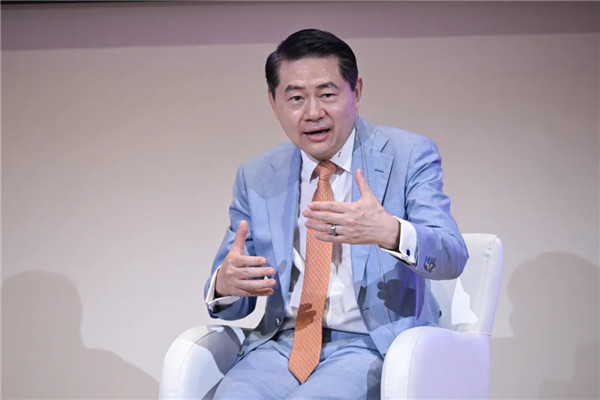
CCG’s official side event at Munich Security Conference
CCG | February 14 , 2026“‘Chain’ or ‘Chasm’? Rethinking Global Value Chain Security and Cooperation Amid U.S.-China Trade Dynamics.”
On 14 February, The Center for China and Globalisation (CCG) hosted an official side event at the Munich Security Conference titled “‘Chain’ or ‘Chasm’? Rethinking Global Value Chain Security and Cooperation Amid U.S.-China Trade Dynamics.” CCG has been invited to host an official side event at the conference for eight consecutive years, and remains the only Chinese mainland institution to do so.

This transcript is based on a recording and has not been reviewed by any of the speakers.

Mabel Lu Miao, Co-Founder and Secretary General, CCG, and Munich Young Leader 2020

Gentlemen, please have your seats. Welcome, all of you. Joining us. It’s my great pleasure to welcome all of you. Let’s start our event. Distinguished guests, ladies and gentlemen, good afternoon. On behalf of the Centre for China and Globalisation (CCG, it is my great pleasure and honour to welcome you to our side event at the 2023 Munich Security Conference, also at the Munich Young Fellows. It is always a privilege to return to this platform.
We are meeting at a time when the global order feels increasingly under destruction, as the MSC 2026 report suggests. Our theme today is concerned with the question mark that captures the existential crossroads facing global value chains. We are moving from an era of efficiency first to an obsession with security, and the choices we make today will determine whether our economies remain linked or fall into geopolitical concerns. To explore these dynamics, we are joined by an extraordinary group of experts. Today, in the spirit of multilateralism, I would like to introduce our speakers in alphabetical order.
Ravi Agrawal, Editor in Chief, Foreign Policy
Ebtesam Al-Ketbi, President and Founder, Emirates Policy Center
Graham Allison, Douglas Dillon Professor of Government, John F. Kennedy School of Government, Harvard University
Matthias Berninger, Vice President of Public Affairs, Science, Sustainability, and Health, Safety, and Environment, Bayer AG
Jonathan Black, Deputy National Security Adviser and Prime Minister’s G7 / G20 Sherpa, Cabinet Office
Jude Blanchette, Distinguished Tang Chair in China Research, RAND Corporation
Adam Chan, Director of the Federal Communications Commission Council on National Security
Cao Yanzhong, Senior Colonel; Research Fellow, Institute of War Studies, Academy of Military Sciences of the Chinese People’s Liberation Army
Dino Patti Djalal, Founder and Chairman, Foreign Policy Community of Indonesia
Michael Froman, President, Council on Foreign Relations
Mikko Huotari, Executive Director, Mercator Institute for China Studies
Jiang Feng, Professor and Chair of the Council, Shanghai International Studies University
Roula Khalaf, Editor in Chief of Financial Times
Magdalena Kirchner, Director Europe in the World, Mercator Foundation
Daniel Kurtz-Phelan, Editor in Chief, Foreign Affairs
Li Cheng, Professor of Political Science and Founding Director, Centre on Contemporary China and the World, University of Hong Kong
Li Shuyin, Senior Colonel; Research Fellow, Institute of War Studies, Academy of Military Sciences of the Chinese People’s Liberation Army
Bronwen Maddox, Director and Chief Executive, Chatham House
Michele Mestrinaro, Vice President and Global Head of Policy, Novartis
Margaux Murali, Director of Asian Affairs for the U.S. Department of Energy
Shannon O’Neil, Senior Vice President and Director of Studies, Council on Foreign Relations
Purevsuren Lundeg, Former Minister of Foreign Affairs of Mongolia
Gideon Rachman, Chief Foreign Affairs Commentator, Financial Times
Jean de La Rochebrochard, Senior Director for Strategic Partnerships and Global Engagement, APCO Worldwide
Carl-Philipp Sassenrath, Member of the Subcommittee on European Law, CDU/CSU Parliamentary Group, German Bundestag
Thomas J. Shattuck, Senior Program Manager, Perry World House, University of Pennsylvania
Siddharth Mohandas, Director in the Geopolitical Advisory business at Lazard
Symeon G. Tsomokos, Founder and President, Delphi Economic Forum
Danilo Türk, Former President of the Club de Madrid; Former President of the Republic of Slovenia
Justin Vaïsse, Founder and Director General, Paris Peace Forum
Henry Huiyao Wang, Founder and President, Center for China and Globalization; former State Counsellor of the People’s Republic of China
Wang Yiwei, Director of the Institute of International Affairs and Director of the Centre for European Studies, Renmin University of China
Ngaire Woods, Dean, Blavatnik School of Government, University of Oxford
Wu Shicun, Founding President, China’s National Institute for South China Sea Studies
Zhang Xiaoyan, Vice President, China Center for Information Industry Development
Maybe not everyone is included, but we welcome all of you. The goal today is to move beyond the rhetoric of “great-power politics” and towards practical frameworks for cooperation, to save the day and share his strategic vision for the future of global value chains. I would like to invite the founder and president of CCG, Dr Henry Huiyao Wang, to deliver his opening remarks and lead the discussion. Okay.
Henry Huiyao Wang, Founder and President of CCG; Former Counsellor of China’s State Council

Thank you, Dr Miao. First of all, I want to extend the warmest welcome to the vice chairman and CEO of the Munich Security Conference. We’ve known each other for almost a decade; we’ve been working closely with the Munich Security Conference, and we see that the Munich Security Council has reached unprecedented scale, impact, and influence. So we’re very honoured to have been partnering with the Munich Security Council and to have run this side event on China. And now it’s become a big, large China trend.
So first of all, I know you’re extremely busy. But we would also like to invite the man who’s running the Munich Security Conference to speak a few words. Dr Benedikt Franke is the vice chairman and chief executive officer of the Munich Security Conference and has been really doing this for many, many years. So we’d like to hear briefly from you. Because this is a joint event. So you must have a very busy few days, and we’d like to hear from you first.
Benedikt Franke, Vice Chairman and Chief Executive Officer, Munich Security Conference

This is now the time for my 45-minute keynote. You know, when I look at your speakers you have assembled here, Henry, you know I don’t want to stand in the way of that discussion, but I absolutely love the fact that you have been such a loyal friend of the conference that you’ve come here even when times weren’t so rosy. You know, criticism of China was very direct and very harsh. And we still had these discussions here. The Munich Security Conference is all about the elephants in the room. China is a pretty big elephant in the room. It has a very prominent place here at this conference, and we’ll continue to provide a platform for divergent viewpoints on China and by Chinese institutions. So do come back often. And I’m going to stay here for a little while and listen to the wise men up here. Thank you.
Henry Huiyao Wang
Thank you, Benedikt. It’s a really great. It’s such a great gathering at the Munich Security Conference. So, dear distinguished guests, colleagues, and friends, and media friends, you know, today is Valentine’s Day. Happy Valentine’s Day, right? We’re having this great event here on such a lovely day.
Benedikt Franke
Henry, you know what I just said? I’m going to stay here and listen. Apparently, I was lying. I’m truly sorry.
Henry Huiyao Wang
Thank you. Thank you for coming. Thank you very much.
Mabel Lu Miao
Thank you. So that’s why we prepare the Valentine’s chocolate. It’s a gift.
Benedikt Franke
Thank you. Okay.
Henry Huiyao Wang
So, a warm welcome to this CCG side event. Today, we gather here in Munich at a time when the Munich Security Report 2026 has given us a title that sounds more like a warning than a theme: “Under Destruction.” So, the topic today is “Chain” or “Chasm”? Rethinking Global Value Chain Security and Cooperation Amid U.S.-China Trade Dynamics.
The report describes a world governed by “wrecking-ball politics”, where the multilateral order built over the past eight decades has been systematically damaged. As a think tank dedicated to globalisation, CCG has found that this trend is accelerating, and that has raised concerns.
As we sit here in 2026, it feels as though the world is still retreating from the “Liberation Day” tariffs and not completely out of that shadow yet. Still, there is hope that things can be sorted out. In this context, the question of “Chain” or “Chasm” is not just academic — it has real-world implications.
For decades, global value chains were built on a single, elegant, and obvious principle: efficiency. The goal was to optimise for speed, cost, and comparative advantage. But as U.S.-China trade frictions have deepened into systematic de-risking, that efficiency-first model has increasingly been replaced by a security-first obsession. In that shift, the biggest risk may be jeopardising prosperity — a risk that cannot be afforded.
Every country has its own competitive advantage. Human beings live in a global village, and should, in principle, do what each does best. But global value chains are under growing strain, and how to collaborate is the key challenge being faced right now.
So, here today, the irony is that the Munich Security Index shows that many of our peers now view these very security measures — tariffs, sanctions, and isolation — as the primary sources of global risk. So, by trying to secure our own individual links in the chain, we are inadvertently digging a chasm that threatens us all. So, we have to be very careful.
Today, I’m not going to take very long — just to raise a few questions. First, we are here to talk about resilience versus restriction. How can we really sustain and build on the global value chain system that we have all benefited from over the last eight decades? This is really about whether we continue, and how we can upgrade and maybe improve our global value chains.
Second, how can we really establish coexistence in this multipolar world? Can regional value chains in the Indo-Pacific or Europe act as building blocks rather than stumbling blocks? Because there are quite a few global value chain centres: the U.S. being one of the largest on the university and innovation chains, China on the manufacturing chains, and Europe on the service chain. So how can we really bring all those together? Are we moving towards open regionalism or isolationism?
Finally, we should prevent their weaponisation. What actionable frameworks — early risk warnings, or rule alignment — can ensure that critical minerals and technologies remain engines of growth, rather than triggers for conflict? As President Xi said during his meeting with President Trump at the Busan summit in South Korea not too long ago, he basically said: let’s get out of this vicious cycle of sanctioning each other. Let’s build up trust. And that is probably one of the ways to sustain our global value chains.
And I know that President Trump is coming in April, and President Xi will probably revisit in the summer. And we’re going to have an APEC summit and a G20 summit. So there will be four occasions when they will probably get together.
So, as a think tank, the Center for China and Globalisation really believes that we should not rush into a “year of destruction”, but continue to make sure that mutually assured construction — not mutually assured destruction — is what is needed. We want to defend the rules that prevent the law of the jungle from returning to global trade and business.
So, that would be the end of my opening remarks—just to warm things up before all the big speakers speak. But first, let me invite our distinguished guests to share some opening remarks as well. I’d like to have keynote contributions.
First, I’d like to invite Michael Froman, the President of the Council on Foreign Relations, a veteran former U.S. Trade Representative, and someone who has visited China many times. The Council on Foreign Relations is a bridge, as is the Munich Security Conference. So we’d like to hear from you—we’ll have about five minutes for each speaker.
Michael Froman, President, Council on Foreign Relations

Well, thank you very much, Chairman, and thank you for having me. I’ll speak just very briefly. I really want to build on what you just said, because I think when I look at the title here, I think you put your finger on it, which is that for the last several decades, our approach to global production has been based largely on efficiency, and that created some great benefits for downstream users of products. It also led to China becoming effectively the manufacturing floor of the global economy. And I think companies, when they had to make a decision, wherever they were from, as to where to put their next factory or where to source their products, it made perfect, rational sense in each individual case to source from China.
I think the challenge is that I think we’ve come to the conclusion that efficiency is an important value. We don’t want to give up completely on efficiency, but it’s not the only important value. And the number one rule of risk management in anything, managing a portfolio or anything, is diversification. And you want to have diversification. You want to have resilience anyway, regardless of anything happening in geopolitics. And then when you layer on the emergence of a geopolitical competition between China and the United States that covers political, military, economic and technological domains, it has put great strain, as you’ve said in this topic, on that notion of global value chains. We’ve seen the total convergence now of economic and national security into economic security.
And that’s happened precisely at the same time that, you know, well, people will raise questions in economies like the United States and Europe: Why not just be a service economy? There is a view, and it can be debated by economists, that manufacturing is important. Manufacturing is an important driver of broader innovation, and no country, whether it’s an advanced industrialised country or an emerging economy like India or Brazil, wants to completely give up their capacity for manufacturing. And that leads to further tension now between the United States and China. And what you rightly said is the weaponisation of interdependence.
And from China’s perspective, it may appear that it’s weaponised through our use of export controls and denying certain products to China. From the U.S. perspective, China’s decision to demonstrate that it could implement a global licensing regime around the export of critical minerals and other critical inputs also demonstrated a weaponisation of interdependence that I think woke up a lot of the rest of the world. And it makes me wonder whether 2025, which is a very important period in U.S.-China relations and China’s relations with the rest of the world, may have seen the peak of globalisation, that now that the tools of weaponisation, whether it’s the licensing scheme or other schemes, have been pulled out.
All parties are now looking at how they can reduce their dependency on each other. It’s been a strategy of China for some time: dual circulation, etc., not wanting to be dependent on other countries, but having other countries as dependent as possible on it. And I think in the U.S., belatedly, quite belatedly, it’s become a priority to say we need to reduce our dependence on China for critical products as well.
Lastly, I would say the Trump administration’s approach to this has been not just the use of export controls or other mechanisms like that, but a theory that if we impose tariffs on other countries, companies will ultimately be required to move their production, move their supply chains to the United States. And if we’re chaotic about how we impose tariffs, even more so because as companies and their executives scratch their heads and say, what is our tariff policy going to be three or 4 or 5 years from now? How can I make a decision about allocating capital like this? The answer that comes to the administration is, well, in this era of uncertainty, the only thing you can be certain about is that if you produce it in the United States, you won’t be subject to this era. And now the question will be whether that theory proves to be right. We see individual, isolated anecdotal announcements of new factories, new investments, but whether or not the U.S. ends up with a substantially larger manufacturing capacity or more jobs in manufacturing very much remains to be seen.
Henry Huiyao Wang
Thank you, thank you, Michael, and you put it very well. Exactly. The key now is to figure out how to move past the perceptions on both sides that each is being restricted, sanctioned, and put under pressure. That’s why a trust-building and dialogue platform like this is so important.
Now, I’d like to invite an old friend, Graham Allison. Professor Graham Allison is the Douglas Dillon Professor of Government at Harvard University, and has travelled frequently between China and the U.S., meeting with many Chinese leaders. I’m also glad to mention that “Escaping Thucydides’s Trap” has been well received in China.
Graham Allison, Douglas Dillon Professor of Government, John F. Kennedy School of Government, Harvard University

Thank you very much, Henry, and thank you and Mabel and CCG for organising this into an interesting discussion. I’m honoured to be a member of the panel. You asked me to try to put it in a little bit bigger frame, the question you raised. So it will take five minutes. I’ll make seven points in five minutes pretty quickly.
So, the first point starts with Thucydides. That’s where I was starting. Thucydides explained to us that when you have a rapidly rising power like China, seriously threatening the position of a colossal ruling power like the U.S., that’s shifting on the seesaw, it’s a great discombobulation and most frequently ends in war. If I were making a bet about the next generation, I would say that’s where it turns out. And I’d make it about 75%. So more likely than not. That still leaves 25% for agency, and I’m pretty hopeful that my title on the topic of U.S.-China relations is on the path to a more constructive and positive relationship in 2026. We’re just looking through the year ahead.
Point two: a reason for more optimism about that 25%, and about human agency, is that we have both President Xi and President Trump — two people who realise that this is Thucydides’s [inaudible], and what the normal outcome of such a situation can be. President Xi is one of those people who has thought about it, as Henry Kissinger said, probably more seriously than any other political leader he had seen. It’s a conception of “I’m in you, and you’re in me”: a complex interdependence.
President Trump has his own version of this, but he is determined to be and to be known in the future as a great deal maker and a great peacemaker, and the great peace to be made is in the relationship between the U.S. and China. So I would say watch this space. Look at the National Security Strategy and the National Defence Strategy — which, if you haven’t read them, you should read carefully — and ask what’s most prominently missing, what’s not there. And I’ll give you a few clues. There’s no reference whatsoever to framing the relationship as a great-power competition. There’s no reference to China as the military hegemon. There’s nothing about a systemic threat to the U.S. in these documents. So this is about trying to reframe the relationship in a more positive and productive fashion. And we’ll see.
Next point, what do the National Security Strategy and the National Defence Strategy say the U.S. wants from China? Stable, peaceful, respectful, mutually beneficial financial and trade relationship, much more business language or corporate statecraft than geopolitics or geostrategy. This is more like the way Tim Cook, Elon Musk, Larry Fink, or Jensen Huang would describe the relationship. This is a business. That’s complicated. It’s competitive, but business deals can be solved, and issues can be resolved.
Next, who’s President Trump chosen to be his interlocutor with the Chinese in the preparation for the year ahead? The Secretary of the Treasury Scott Bessent, not the Secretary of State, not the National Security Advisor, or, since we don’t have one, the two Deputy National Security Advisors. So this is He Lifeng and Bessent preparing to get from the truce that they have now to a deal that might actually be [inaudible]. And then beyond that, they’re dealing with each other in very businesslike terms, I would say so.
So why is this? I’d say President Trump has said he can have a presidentially driven relationship with China. He understands that most of his government, most of the people that work in his government, come from the traditional bipartisan, much more hawkish, much more hostile views of China, but not him. And he believes he can frame this relationship in his own terms. And the possibility that there’d be four meetings among the leaders would be a very important way to drive that.
So what was the biggest discovery in 2025 about the relationship? And I would say it was economic pain. So President Trump is a bully. He bullies people that he can get away with bullying. But in Xi, after Xi pushed back with 145% tariffs and then the threats of war squeezed the supply chains for rare earth magnets, President Trump said uncle—or “TACO,” as the Financial Times carefully put it.
So when you come up against somebody as strong as you are, you have to adapt and adjust. President Trump has adapted and adjusted. Actually, 51:21 [inaudible] Xi describes this, it’s way more candid, almost like true confessions, so that I would be, because it displays a vulnerability. Well, this is the relationship that he seeks that we have for the period ahead.
And given that he’s focused on November 3rd, which is the Congressional elections, which will be essential for his rule for the remainder of his term, he believes that a good relationship with China, and therefore a good economic relationship, is necessary for a strong American economy, which he thinks is necessary for him to win in the midterm elections, which he thinks is necessary for his rule. So this is something he’s very tight with them.
So I think as we look to 2026, I would say it’s quite likely we’re going to see a reframing of the relationship in a much more positive and constructive fashion. I would say it may look something like a partnership. Maybe the Partnership for Peace and Prosperity, hoping in terms it would be called the great beautiful whatever partnership.
Now you might ask: what content will be interesting to watch? And that’s only for 2026. Finally, I think for all of us, we have to become better Trumpologists. So in the old Cold War, Europe and the Soviet Union. We studied Sovietology. And you had to try to read where people stood as they looked. And you read between the lines, and you listen to the various things. You can’t take everything literally, but you can take him seriously, because you often see patterns. One of the people who follows him best, I think, describes him as “Mr Trump and Dr Hyde”. And you never know which one will show up at each meeting.
Henry Huiyao Wang
Thank you. Thank you, Graham, for your very comprehensive analysis. I still remember that last year you predicted that China–U.S. relations and President Trump’s approach toward them were improving. And now we see some signs of that. I think this is a good start. They just had a phone call about two weeks ago, and I understand that President Trump will be coming soon. So there is hope that this momentum will continue.
Maybe, as you said, in 2026 there could be a new partnership, or perhaps a new framework for China–U.S. communication, or a new phase of development, whatever form it may take. The hope is that many constructive things can happen in 2026.
Now I’d like to invite another opening contribution from Danilo Türk. He was the former president of the Club de Madrid, which brings together about 100 former heads of state and government, and he is also the former president of the Republic of Slovenia. Danilo, please.
Danilo Türk, Former President of the Club de Madrid; Former President of the Republic of Slovenia

Thank you. Perhaps I should add that for the theme of this meeting this evening, another piece of information may be more relevant. I am also a great admirer of the World Trade Organisation, and have followed the developments as an academic for many years, and have always been fascinated by the processes which have reduced tariffs enormously in the past and have created an impression, perhaps an illusion, that tariffs are a matter of history. Now history has returned with full force, and now we see tariffs as a major instrument of economic transformation of the world.
Now, where that leads to is not really very clear, but it is clear that we live in a different world now and that all avenues for improvement have to be tested and discussed. And I think that the Munich Security Conference is a good place to do part of that discussion.
And here, since we are meeting in the context of the security conference, I would like to start with a note of caution, because nowadays it is quite fashionable to start any discussion with quoting Thucydides and his famous Melian Dialogue. The powerful do as they please, the small and weak suffer as they must. Well, that, of course, is an important historical message. But it is not the only one. The other message is that this serious work by Thucydides explained how the powerful lost that war at the end. And therefore, one has to look at the entire complexity of things.
Now, what does that have to do with international trade relations? I think it has much to do with the trade relations, because we have seen how tariffs are being used as an instrument of power. And the question is, what can be done and what should be considered as a possible next step or a way forward?
Here, things become more complicated because tariffs bring a certain paradox. They are not welcome generally, but they are understood as being necessary at this moment. I think one conclusion which one can make based on this diagnosis is all right, but where would innovation come from, and what could that innovation be? And does that innovation need to address the international trading system more generally?
And here, another historical, more recent experience comes to mind. I remember the time when the United States proposed the World Trade Organisation—at that time, still the General Agreement on Tariffs and Trade—to start dealing with services. And I remember how big that shock was because it was seen by most people: Well, you know, GATT is about trading goods. What do services have to do with that? But there was this Uruguay round of negotiations, which has produced very interesting agreements. At the end, after several years—not a very long period, I mean, historically speaking—but it has transformed everything, created an optimistic moment which allowed the creation of the World Trade Organisation a little later.
So, having this sort of experience in mind, I would like to conclude with one specific question, since our theme today is “Rethinking Global Value Chain Security and Cooperation Amid U.S.-China Trade Dynamics.” And of course, that trade dynamics include a combination of trade, economics, and national security issues. So that makes it very, very difficult. Nevertheless, the question is, shouldn’t we start thinking about innovative approaches in the multilateral trading system? Is the World Trade Organisation a place where some kind of creative thinking can be launched, or can be perhaps tried, perhaps with a working group? That doesn’t have to be very ambitious at the beginning, but looks into the entire range of experience with tariffs in the past years and in a variety of value change developments that have taken place, and perhaps has an ambition to propose something for the multilateral system of tomorrow. So that’s the kind of optimistic suggestion which I would like to put before you. I’m not sure whether the time is ripe for that. But perhaps before the ripeness of the time, maybe it’s not too bad to start discussing these sorts of ideas. Thank you very much.
Henry Huiyao Wang
Okay. Thank you, Danilo. That’s a very good idea. It’s important to start thinking and talking from that perspective, and to identify solutions that can stabilise tensions between China and the U.S., and also among other countries as well.
Now, just before we open it up for discussion, I’d like to invite Mr Cao Yanzhong. He is a Senior Colonel and Research Fellow at the Institute of War Studies, Academy of Military Sciences of the People’s Republic of China. The reason we invited him to join this roundtable is that they are participating in the Munich Security Conference for the first time, and they also run the Xiangshan Forum in Beijing. The Academy helps organise that dialogue, which is also a major international forum. So I’d like to invite Senior Colonel Cao Yanzhong to give a brief introduction and share a few remarks.
Cao Yanzhong, Senior Colonel; Research Fellow, Institute of War Studies, Academy of Military Sciences of the Chinese People’s Liberation Army

Thanks to CCG for giving me a chance to share my views on the global value chains. I will discuss the challenges and the destruction of global value chains from the perspective of geopolitical competition.
We have observed that the United States has almost launched a tariff war against the world, imposed technical blockades, and attempted to build new supply chains while using them as tools of geopolitical competition. On one hand, the United States’ efforts to restructure industrial and value chains are contributing to the gradual formation of a parallel economic and value-chain system. This is an integral part of the deglobalisation process, pushing the world from a cooperative order based on multilateralism and WTO rules toward a more confrontational one based on unilateralism and bloc divisions.
On the other hand, we have also observed that allies and partners of the United States have increased investment and industrial transfers to the U.S., such as Japan and South Korea. In contrast, industrial cooperation between some European countries, including Germany and China, is actually stressed. For example, the German chemical group BASF has implemented its largest overseas investment project to date in Zhanjiang, China, with a total investment of €10 billion, making it the company’s third-largest integrated production base globally. China’s largest battery manufacturer, CATL, has invested $2 billion in Germany and already employs nearly 2000 German workers, making significant steps in the expansion of China’s electric vehicle industry into Europe.
These examples demonstrate that the United States attempts to create a parallel value chain system insulated from China, which goes against the tide of globalisation, are not only immensely costly and difficult, but also lack popular support.
It must be said that after more than three decades of remarkable globalisation, the international division of labour has grown closer, and production efficiency has continuously improved. Efficiently functioning global supply, industrial, and value chains benefit the economic development and social progress of all countries. Deglobalisation, however, not only violates economic laws but also runs counter to the global aspiration for peaceful development and win-win cooperation.
To advance a more equitable, open, and inclusive globalisation—and to build a robust, resilient, and orderly global value-chain system, first, we must firmly oppose unilateralism and maintain an open, inclusive, and standard international trade order. Secondly, we must steadfastly uphold the international economic governance system, with the United Nations at its core and WTO rules as its foundation. Third, we must actively promote international, bilateral and multilateral economic and trade cooperation. Fourth, we must focus on building a rule-abiding, win-win, and more resilient global value chain. Thank you.
Henry Huiyao Wang
Thank you, Colonel. So, I think we can now open up the discussion. We’ve had enough introductions from our opening speakers. Perhaps we can go around the room. Maybe we’ll start with Daniel. We have about 45 minutes left, so let’s say three to four minutes for each speaker.
Daniel Kurtz-Phelan, Editor, Foreign Affairs; Peter G. Peterson Chair, Council on Foreign Relations (CFR)
Okay. Well, thank you so much, Henry and Mabel, for doing this again. I will be quite brief, because I don’t want to take up too much time for team Council on Foreign Relations. Especially because Shannon O’Neill is the one who really knows about global supply chains here. So she’s the one who should talk at greater length.
Let me offer a framework for understanding the U.S.-China dynamic at this moment that is fairly optimistic, especially by the standards of the world today, but an optimism that is undergirded by extremely low expectations, which I think are critical to maintain.
Why am I optimistic? I think when you look at both sides, when you look at Washington and Beijing, you sense a high degree of assurance on the part of both governments that time is on their side in key areas. So things have been extremely competitive. It’s been a year of the trade war and weaponisation of vulnerabilities. But when you look across the key areas of the relationship, I think you see both sides who look at the Taiwan Strait and think things are moving in their direction. Both sides have pieces of evidence they can point to. If you’re sitting in the Chinese government, you can look at the KMT visits and the state of politics in Taiwan and what’s likely to happen in the next election. And that looks pretty good for you. If you talk to the U.S. military and see what’s happening in Japan, that looks pretty good from a Taiwanese perspective. When you look at tech and how they think about innovation and what it means to be ahead in the tech race, they have different visions of what that means. But both think that they have the upper hand, that time is on their side.
Similarly, I think even on supply chain weaponisation, on weaponised interdependence, there’s a lot of confidence among people in the Trump administration that the rare earths problem will be solved on a short timeline. They may be wrong about that, but you hear that confidence from them. And I think it’s even true when you look at allies and partners and relationships with the rest of the world. The Chinese, of course, have a lot of reason to think that American allies, traditional partners, will continue to make pilgrimages to Beijing and that there’s an opening there. But you hear a lot of confidence from Trump officials that for all of the dissension and all the turmoil in the relationship over the last year, that ultimately they believe these alliances will be solid and emerge stronger, not just because of more defense spending, but because, in their view, most American allies in Asia and Europe just don’t have other options and are going to go to China, test the waters there, but ultimately come back into the fold.
This is a good thing to my mind, because I would like both sides to think that time is on their side, rather than they need to make a desperate move, as we see in Graham goes back through this history in more detail and depth than I certainly can. But that is the scary situation when one or both parties think that time is working against them, and they have this one chance to make a desperate move.
So, to me, this confidence again, one side’s going to be wrong on most of these, but I would like to maintain that confidence as long as possible. A couple of risks, one I think would be overconfidence. You see glimmers of this again on both sides when you read some of the discourse. Jude Blanchette can probably talk about it in way more detail than I can, but when you read some of the Party-adjacent discourse about the decline of the West and China’s moment, that to me suggests a degree of overconfidence. But again, if we kind of stay on the right side of that confidence/overconfidence line, that strikes me as a much better place to be than we’ve been in some years.
And then looking ahead to April, when Trump is still set to visit Beijing, I think this really depends on having very low expectations for that visit. Not expecting a new relationship of trust, not expecting cooperation, not expecting an end to this mutual weaponisation of supply chains or use of tariffs or other tools, but to try to find a way to use those tools to compete calmly and with a degree of patience and assurance. That’s a fairly low bar compared to where we might have been, but I think that’s a pretty good place to be. Let me also just remind Graham, I think at this event last year, we made a bet about whether it would be a Taiwan communique. So in April, we need to collect on that one way or another.
Henry Huiyao Wang
Thank you.
Graham Allison
I get to the end of 26. Is it?
Daniel Kurtz-Phelan
I thought it was the first visit, but, well.
Henry Huiyao Wang
We made a bet the last time around this table, on the same occasion, about whether China–U.S. relations would improve or worsen. It seems that we’re seeing a bit of improvement now. But thank you for your excellent comments.
I know Dan runs Foreign Affairs, one of the most influential magazines. And as you know, we also have a Foreign Policy editor here—Ravi is with us. So you make a significant impact on the world through those well-known journals.
But I think you’re right: it’s important to have expectations, while also preparing for realistic outcomes. That’s something that needs to be done. At least now we seem to be in a kind of transitional process. If there are four summits ahead, then it’s important to make sure that nothing goes out of control. So it’s a good thing that heads-of-state diplomacy is still working.
Now I’d like to invite Zhang Xiaoyan. She is also here in Munich for the first time, and she is the Vice President of the China Center for Information Industry Development, so she has extensive experience. If you’d like to say a few words, please feel free. We’ll go in turns, and hopefully everyone will have the chance to speak.
Zhang Xiaoyan, Vice President, China Center for Information Industry Development
Okay. You know, I’m still suffering from jet lag, so at this time, Beijing time, it is already midnight, and my brain is not working very well. But it was a surprise to see Mr Froman here, the former USTR representative. I used to work at the Ministry of Industry and Information Technology, and we had a consultation mechanism with USTR and the DOC, the Department of Commerce, called Industry and Competitiveness. I just wonder whether you remember that or not.
At that time, we talked about overcapacity and related issues. But back then, overcapacity mainly referred to iron and steel and other traditional manufacturing sectors. Nowadays, however, overcapacity often refers to batteries, solar panels, and new energy vehicles. So things have changed over the last few decades. That is my general feeling.
Yes, on supply chains and industrial chains, I think that in the past, under globalisation, industrial and supply chains were highly efficient and low-cost. But nowadays things have changed, and we use a term called the “impossible triangle” to describe it—the impossible triangle between cost, efficiency, and security. If you want to achieve low cost and high efficiency, you may think it is not secure. But if you de-risk and simply follow de-risking policies in practice, then the cost may be high and the efficiency low. So we do not think this kind of “impossible triangle” is a good thing.
So, actually, I also want to say that at this MSC, I have heard a lot about the “flooding” of cheap Chinese goods, and many people are blaming China for that. But from my experience, I think the low cost and high performance of Chinese goods are the result of the hard work of Chinese workers, the heavy investment in innovation by Chinese manufacturers, and also market competition and economies of scale, because China has a huge market.
So I believe that this low cost and high performance are not the result of subsidies, or of some of the criticisms I have heard in recent days. Just yesterday, I was here talking about innovation in China and China’s open and cooperative mindset and philosophy. So I just want to reiterate again: China is not a threat, and Chinese goods are good for Europe and other countries. They add more choice for consumers, lower costs, and are also beneficial for achieving the SDG goals of the 2030 Agenda, because China brings many strong green products to the market.
So we can join hands to do better and do more, instead of criticising or blaming each other.
Henry Huiyao Wang
So, thank you. You’re clearly very experienced, and now also with CCIID, a very important think tank in China as well. You’re right: many factors have contributed to this. But I also think that globalisation, the WTO, and foreign investment have all contributed to the efficiency China has achieved. So perhaps all of these factors need to be taken into account now.
Dr Justin, you are leading the Paris Peace Forum. You are the founder of the Paris Peace Forum. And Dr Justin also served at Brookings 15 years ago. So we’d like to hear your point of view from France as well.
Justin Vaïsse, Founder and Director General, Paris Peace Forum
Thanks. So whether elephants make love or war, the grass gets crushed. You know the famous African proverb. And so, since Benedikt likes to talk about the elephant in the room, I thought these two other elephants would be interesting to bring up, because I was getting worried as Graham and others were relatively optimistic on the Trump visit. If they will make love rather than war. That would be better. But Europeans, in any case, are finding themselves between a rock and a hard place. And I just wanted to say a few words about that situation of the Europeans.
Because, on the one hand, we’ve seen in the last year the tariffs, and that has been very unpleasant, because tariffs and commercial relations were the only place where Europeans could actually have a good rapport de force, a good balance of power, with the U.S. But of course, they didn’t use it because of Ukraine. And so the Turnberry agreement was, I think, terrible, but at the same time, I approve of it because it was meant to protect Ukraine from any retaliation on the commercial aspect. But Europeans resented that quite a bit. Plus, the undermining of international institutions, the WTO in particular, and then Greenland. So there is a deep sense of betrayal and insecurity that will not be erased soon. I mean, what happened, you know, it’s done. Greenland is probably not coming back on that, never—well, never say never, but probably not. But the damage is done. And I think there’s a sort of silent upheaval in transatlantic relations, a commotion, if you like, that will not go away.
Plus, there’s another aspect, which is climate. I mean, what just happened yesterday, what we saw on the climate “hoax”, all the terrible lies, or imagination, of President Trump about China not producing wind power, whereas it produces 40% of wind power in the world. I mean, seen from Europe, it really looks bad. We don’t want to become a petro-state like the U.S. First, we don’t have any oil, and we don’t have much gas. We do have a bit of gas, beautiful gas from the North Sea, but we don’t have that. We want to become an electric state, right? And so, in this case, China is the sort of natural partner.
And then I’m coming to the hard place now. When Europeans are turning to China, what they see is not very encouraging, right? Because they see overcapacity. And I’m sorry, but it’s a reality. They see 12 million small packages arriving a day in the EU. So that’s about 6 billion small packages. And that has increased enormously in recent few years. And it’s become a big problem, because it’s not just eating the lunch of many manufacturers and producers, but it’s just killing whole swathes of industry.
And they also see a China that has gone up the value chain. To its credit, it’s getting better and better at many things. There are basically Teslas that are better than Teslas and that are like a third to two-thirds of the price.
And so that’s what Europeans see. So the good dispositions they are in because of the Trump administration since a year ago are sort of contradicted by the fact that it’s hard to engage China on those terms. And they have the impression of being the variable that you can adjust when you’re losing parts of the U.S. market, and that you’re being clobbered on the one hand, and then, of course, you find yourself in a hard place when you try to escape the rocks.
So I think there’s deep ambivalence on these issues of trade and value chain in Europe. Some are saying we should do what China did 20 years ago, that is, welcome industries, EVs in particular, but of course insist on transfer of IP, which was done 20 or 30 years ago in many, many industries. Others are saying that our policy shouldn’t change just because the U.S. is giving us the cold shoulder, and we should just maintain our position.
Bottom line, I don’t know what exactly it will be, but there’s a much keener sense that we should de-risk, not just from China—and that was, a couple of years back, von der Leyen’s famous call for that—but also from the U.S., and that we are just a bit more lonely in that competitive world. Thank you. And thank you for getting us together every year. It’s really good to sort of follow and chronicle the state of China-West relations. Thank you, Henry.
Henry Huiyao Wang
Okay. Thank you, Justin. Yeah, very good. I mean, you talked about those reversals. Actually, I was talking to Pascal—maybe 40% of those EVs are actually made by multinationals in China: Tesla, BMW, and others. And in the future, we could have JVs going back to Europe, with China-EU joint ventures based in China. So, thank you for the comments.
I know that Shannon O’Neil is going to leave, but you are the expert on this. She is the Senior Vice President and Director of Studies at the Council on Foreign Relations. We’d like to hear from you.
Shannon O’Neil, Senior Vice President and Director of Studies, CFR
Thank you very much, and I’m sorry to jump the queue, but I have to go do a debate in a minute. Let me just say a few words about global supply chains, since that’s the topic more generally.
I wouldn’t think it’s too early to say that this is the death of the global supply chain. If you look at trade last year, it was up about five, almost six per cent. So trade was quite robust vis-à-vis overall global economic growth. And when you look at that trade, still about 75 to 80 per cent of it was intermediate goods—the inputs that go into final goods. So supply chains are still very robust. People are trading much more in things that go into products rather than the products themselves.
Now, we do know that direct U.S.–China trade went down. But the big growth that we saw was trade between other regions, particularly China, double digits with Africa and with Latin America, and high levels, almost double digits with Europe, not quite, but there is a lot of movement of trade around, so that’s one thing.
The other thing I would say is that the distance over which trade works has not declined either. In fact, it has gone up slightly. So the average kilometres or miles that goods travel has edged up just a little.
So we’re not seeing a pullback. There is still a lot of movement all around the world. But what we are seeing—and to Mike Froman’s position and some of the others mentioned—we are beginning to see diversification. The trade that is happening is moving between different countries than, say, five or even ten years ago.
We do find that there is more trade between countries that consider themselves allies. Countries that vote more similarly in UN votes and the like are now trading more with each other than they did in the past.
And I think we are also beginning to see bigger shifts in supply chains around the kinds of industries that people believe are critical to national security. We’re seeing bigger moves in supply chains around pharmaceuticals and the inputs that go into them. We’re seeing bigger shifts in electronics and some of the things that go into them. We’re also seeing bigger shifts in machinery and other kinds of capital goods that are important inputs.
So, as I look at this overall landscape, the one thing I would be watching is where foreign direct investment is going, because that is the trade of the future, particularly since so much of it is going into inputs rather than the final product. So thank you for letting me speak.
Henry Huiyao Wang
Thank you, Shannon. Great comments. So perhaps we can just go quickly — whoever would like to speak. Ravi, are you okay? Okay. Dino, please. Thank you.
Let me introduce you. You are also running a major think tank in Indonesia, and I have just witnessed how big an impact you have there. So please. You are also the former Deputy Foreign Minister of Indonesia and former Ambassador to the United States.
Dino Patti Djalal, Founder and Chairman, Foreign Policy Community of Indonesia
Henry, it’s good to see you as well. I just want to comment a little bit on what Graham Allison said. I took note of what you predicted, that this year there’s going to be a new framing, and hopefully a better framing of the U.S.–China relationship. And I welcome that, because in Indonesia and Southeast Asia, we are quite worried about the direction of geopolitical rivalries.
But I would also want to say, as much as I hope that will happen, that in that new framing, it’s not going to be a stable relationship. Because if there is anything consistent about Trump, it is inconsistency, right? And also, there’s a very strong game of one-upmanship between China and the United States.
One example was Biden previously strongly supporting a program called JETP to take coal out of our energy system, and the U.S. was the biggest contributor to that. But then Trump pulled out, and that program is sort of in limbo. And then President Prabowo said we’re going to do 100 GW of renewables. And guess where it is going through? China, right? So China said, “Hey, we are a better alternative, and we are more attentive to your needs.”
Another example was when we had visa problems for our students. The moment that happened, China came up with a statement saying we’re going to give five-year free visas to all students coming from ASEAN. So I think President Trump, who likes to win, manages relationships in ways that would not deliver a stable relationship. So that’s one point.
Second point, and this reflects Justin’s point as well, even though there may be a new format for the relationship between the U.S. and China, what will remain is a sense of mistrust, anxiety, and even fear toward the Trump administration. It doesn’t go away, no matter what. In fact, for many of us, in the Trump administration, strange is the new normal, right? And again, I’m just being candid about this.
My president is going to be in Washington, D.C., to sign a tariff deal, while also attending the Board of Peace inauguration. But during the negotiating process, the things that were asked of us from the Trump administration side were things that I think were never asked of us by any country before. I’m not at liberty to say what these are, but it feels like a tributary relationship—is that how you say it? To pay tribute, right?
And in fact, the question becomes: how do you avoid him getting mad? What kind of compliments do you give? How do you praise him? It’s not a normal set of talking points that we would use with any country in the world, right? So that sense will remain.
And the third point is—again, this reflects some of the previous comments—the countries that President Trump is clobbering are coming together. Indonesia and Brazil are coming together. Indonesia and South Africa are coming together. A number of others as well. Indonesia has joined BRICS, and so on. So I think this is a trend that will continue for the rest of the Trump administration.
Henry Huiyao Wang
Okay. Thank you, Dino. I see Symeon G. Tsomokos also raised your tag. I know you are the founder of the Delphi Forum in Greece, very, very famous too.
Symeon G. Tsomokos, Founder and President, Delphi Economic Forum
I’m honoured to be here. Thank you very much for the invitation. I would only like to offer a comment historically, because we have the privilege of having Professor Allison here with us. Thucydides describes the rivalry between Athens and Sparta in the fifth century BC. The reason why Athens is losing the war is because they lost the allies by the end of the day; they had such policies which disturbed all the allies. And this is why they were left alone. And this is why, by the end of the day, Sparta won the war. I think this is a big lesson for the United States, and perhaps in the future it may be a lesson for China as well. So, professor, please correct me if I’m wrong.
Henry Huiyao Wang
Great. Thank you so much. You run a very good forum, Delphi Forum in Greece, year after year. So congratulations. Maybe. Ravi, you also run an important magazine. That’s very influential.
Ravi Agrawal, Editor in Chief, Foreign Policy
Well, thank you, Henry. Thank you, everyone. I’ll just be very brief, because there are so many China experts here who know more about this topic than I do. I’m just going to say one thing as a general reflection.
Over the last two days, listening to the Secretary of State’s speech this morning, I was struck by how, even on stage, so many of the remarks were about relief or feeling reassured, when in reality the remarks were not that different. It was just tonally different. And it tells me something that I think we all know: we are entering a sphere of coercive diplomacy, with a United States that wants to use coercion as a way to bring countries onside. And I smell a lot of fear.
In the last two months, there has been a lot of discourse around middle powers, in particular Canada and Mark Carney’s speech about the need to band together, as Dino, you just said. I think it’s interesting to see that trend line take off. It will be interesting to see what they do together. But the thing that worries me the most about that trend line, if it does take off, is that it is very unstable, as you pointed out, because middle powers have a lot more that sets them apart than they have in common. Number one.
Number two, we don’t have that many middle powers. There are a lot of countries that are not able to form clubs, that are not in the EU, that are not like New Zealand that has Australia right next door to them. Those countries, small countries, which are the majority of countries in the world, are essentially unmoored right now. And I think those are the ones that need stability the most. Those are the ones that need rules the most. Those are the ones that don’t have the ability to launch big industrial policy projects that would allow them to protect their industries from friction between the bigger powers.
I’ve seen that discussed very little in the last two days, and also frankly, over the last year. And eventually, these are problems that will catch up with the bigger powers. And I worry about that a lot.
Henry Huiyao Wang
Thanks, Ravi. You’re right. Actually, I was just talking to CDU leaders today at a bilateral meeting. They said the Munich Security Conference is too European-centric, whereas the vast majority of countries in the Global South are underrepresented. So that may be something to improve in the future.
So, I don’t know if any speaker would like to raise their tag. Ngaire, you are the Dean of the Blavatnik School of Government at the University of Oxford.
Ngaire Woods, Dean, Blavatnik School of Government, University of Oxford
Henry and Mabel, what a pleasure to be here, and thanks for bringing us each to Munich, really to hear different Chinese perspectives on what’s going on in China. And in that spirit, I’ve really just got two questions, but I’d love to get answers rather than just put the questions on the table.
The first question is: as Shannon said, and as others have said, global value chains have given companies, large companies, a huge amount of competition to keep them effective. And Chinese companies have been real beneficiaries of that competition to stay lean and productive. So as the world fragments, and as we see a different model come out of the United States, a model nobody has yet talked about, in which there’s quite a high degree of quite brazen—what I would call—state corruption emerging. And of course, what we know about that is that it creates bad business, right? It makes companies slow, fat, rent-seeking, and corrupt. So I’m really interested in how China is seeing the weakening of your competition, the weakening of the framework within which your companies compete. As global value chains fragment, how is China going to keep its own companies efficient, nimble, and competitive when the competitors are not?
And the second question I had was really just: the one thing that surprised me in the Chinese foreign minister’s talk this morning was his extraordinary vehemence about Japan. And I’d just like to know—I’d really love you to decode that a bit for me. Was it an attempt to say to Japan, “Get back in your box”? Was it—as some people might say—perhaps an over-interpretation of what was campaign rhetoric? I’d just love to hear what you think about that, and to explain it a bit to those of us who are not China experts like you.
Henry Huiyao Wang
Okay, good. Thank you. Maybe the first question, Yiwei, I see you put the tag there, and the second question, maybe Shicun, you can answer as well.
Wang Yiwei, Director of the Institute of International Affairs and Director of the Centre for European Studies, Renmin University of China
As a professor of Chinese diplomacy, I have an obligation to answer that question. China is worried about Japan for three reasons.
Firstly, last year was the 80th anniversary of World War II, and the Japanese Prime Minister used a similar narrative about how, in an emergency, they launched the war, and the Minister of Foreign Affairs said that as well. So this is very sensitive.
Secondly, the Prime Minister also mentioned moving closer to being a nuclear country. If Japan, like Germany, were to become nuclear, China would worry. Japan has nuclear weapons potential. Then think about China being surrounded by nuclear powers: Russia, Japan, North Korea, and if South Korea also follows, as some have said, and even Taiwan before that — okay, Pakistan and India as well. So China is surrounded by nuclear weapons. This is the most dangerous situation Chinese people can imagine. China was the only country to suffer from nuclear blackmail. When China had the border conflict with the Soviet Union in 1969, Khrushchev wanted to use nuclear weapons to destroy 20 or 30 cities, including Beijing and Shanghai. So China has that kind of historical feeling about nuclear issues.
Thirdly, now it is 80 years since the founding of the UN. The UN stands for peace as well as decolonisation. Japan colonised Taiwan for half a century, and the Korean Peninsula as well. Now they use the same language of an emergency or crisis over Taiwan. Are they thinking about Taiwan as part of Japan? Of course, that makes China angry.
Okay, briefly, I’ll come back to my comment on global value chains. Of course, as a professor of history, there are three classics I should mention. Number one is the Tao Te Ching. I think it helps us better understand this: risks and opportunities always come together, as in a crisis. We have problems in global value chains because we have to develop. It is like food security and food safety. Everybody talks about food safety, but look at Africa — many places still have food security problems. Those that have not joined globalisation, like North Korea or many other countries, still remain at the bottom of the global value chain. We should pay attention to that.
She mentioned the SDGs. I am the Jean Monnet Chair Professor, and no one mentions the SDGs any more. It is only Ukraine, Ukraine, Ukraine. Yes, Ukraine is important, but the SDGs are also very important. Poor people are also very important.
Number two, I think we should understand the I Ching — change, okay? This is also a Chinese classic. Change is like flowing water. If water does not flow, it becomes dirty; it does not grow. And that is a big problem for everybody, right?
So finally, Confucius, okay? Public goods should be provided for the public. Huawei has a motto that says you can win a war through strategy, but a campaign can only be won through harmony. So if you visit Huawei headquarters, you will see that. Huawei prefers working with the United States, even if you kidnapped the daughter, as was done to Meng Wanzhou. But I think we should take lessons from the Chinese classics.
Henry Huiyao Wang
Thank you. Maybe, Cheng Li, you can say a few words. The mic is there.
Cheng Li, Professor of Political Science and Founding Director, Centre on Contemporary China and the World (CCCW), University of Hong Kong
Well, on the question about Japan, I’ll go back to what Daniel said earlier: that China perceives time as being on its own side. I believe this is the top leadership view, particularly on Taiwan. They may talk very tough, but in reality, they will be very cautious, for a number of reasons. One of them is that there is a very strong view that the Chinese do not fight the Chinese. They think the Taiwanese are part of the Chinese. Of course, some Chinese diplomats have said that if the Taiwanese claim independence or no longer consider themselves Chinese, they can use force. But that will not stand. Even mainland Chinese will not buy that. So I think that means they will use other means to apply maximum pressure, including with Donald Trump.
Now this comes to Japan. Yiwei already said, there are a number of reasons, and the question of Japan’s nuclearisation is important. And this is also part of what Wang Yi said, to reaffirm that China will continue maximum pressure, because after the election, there has been some kind of rethinking. But that is a very clear message: China will continue to go for it. Partly, they are actually upset with the Trump administration. They think it supports the Prime Minister of Japan, although not so publicly. I think this will be part of the discussion.
Now, even before Japan, I also want to turn to Wu Shicun and say that China experts I talk to believe the South China Sea is probably more dangerous. Part of China wants to give a lesson to other countries. They also talk about Taiwan and many other things. But now, when it comes to Japan, this is a real strategic issue.
And history is also very, very important in the Chinese mind. They are also upset with Singapore. When the Prime Minister said that Singapore wanted to take a neutral view, the Chinese actually kept quiet, but they were really very angry about the new Prime Minister of Singapore’s view on Japan. So I will pass to Wu Shicun.
Wu Shicun, Founding President, China’s National Institute for South China Sea Studies
Okay, I just want to add two points to explain why Wang Yi made such harsh criticism of the current Japanese administration. Professor Li just mentioned one reason. Another reason is that in the last couple of years, Japan has gradually deviated from its One China policy and intensified its official relationship between Japan and Taiwan, and publicly or implicitly supported Taiwan separatist forces for Taiwan independence. This is so sensitive.
Since the war between China and Japan in 1895, Taiwan was ceded to Japan. And after World War Two, Japan surrendered, and China recovered Taiwan. The Taiwan issue is so sensitive. That’s why Wang Yi commented on last November Takaichi’s remarks, that “Taiwan’s emergency is Japan’s emergency.” So these factors combined together make the issue very sensitive. It is not only one reason. There are many sensitive reasons together.
So once again, thank you, Dr Henry Wang. From my memory, this is the fifth or sixth time I have attended a side event hosted by CCG, just like Professor Allison. You bring together experts from both home and abroad to discuss important issues of concern. So congratulations, and I appreciate your contribution as a Chinese think tank, using the Munich Security Conference platform to discuss important issues together. So once again, thank you.
Henry Huiyao Wang
Thank you, Doctor Wu. I see Jude. You used to work at CSIS and now at RAND. You are switching between the big think tanks. What’s your point?
Jude Blanchette, Distinguished Tang Chair in China Research, RAND
It’s a question, actually. And I wonder if I could bring it back to the topic of global value chains. And a question for anyone, but maybe Mike and Henry, a question directed at you initially is, we’re obviously hurtling towards a new future of revolutionary technologies: AI, quantum. We’re already starting to see with the Trump administration’s details TBD, but a new preferential trade agreement around rare earths, critical minerals, in some sense connected to thinking about a future of AI and securing supply chains.
When you look into a crystal ball, Henry, I’m asking you because I’m curious where the state of thinking is on this. And, Mike, you’re thinking about as we’re seeing the collapse of the breakdown or deterioration of one trading order with the emergence of a new one is, when you look five years out, ten years out, how do you see either unilaterally, how is China going to get a deal with this? How is the United States going to deal with this? And also, do you see, is there a multilateral space for thinking about new agreements, regimes to help regulate the growth of these technologies, recognising that the genie is out of the bottle of concerns of vulnerabilities? The economic security genie is out of the bottle. We’re not going back to 1995.
So those parameters and constraints are going to stay there. But, you know, we’re going to probably have much more data moving cross-border for training models. Once we have much more of an AGI where we’ve got AI and robotics, we’re going to have production cross-border. So what does the regulatory regime at a national level for the United States and China look like, and how will it differ? And then do you see that this is a space where there might be room for collaboration to think about what a global trading regime could look like in the future?
Henry Huiyao Wang
Okay, good. Maybe I’ll just briefly mention that I think we’re running out of time. I think this current chaotic situation cannot be sustained, even on top of the intensified geopolitical rivalry.
So what I think the possible five- or ten-year scenario is—at least, as far as China is concerned —this: in the 1980s or 1990s, Chinese companies were in China, for China. Township enterprises were selling in China. But after the WTO, multinationals came to China, and China became the manufacturing hub of the world, in China, for the world.
Now China has started a new momentum in China, for the world, because there is a lot of investment everywhere. And Chinese talent—for example, Jensen Huang said 50% of AI talent is coming from China, and 30% from the U.S. So I think that kind of model means we could become more intertwined. In the last 40 years or so, ten million Chinese students went to the United States. So we see this flow of talent, goods, and services intensifying.
And we also come to the European side, where we have more reinvestment in Europe, with JVs of multinationals. Tesla has already set a good example. And Apple made record sales last year in China. Also, 80% of Apple phones are manufactured in China. There is no security issue with that. So I think we probably have to intensify this kind of recoupling rather than decoupling, so that we can be safer in the future. So that is the hope we can really hold on to.
But I agree with you: areas like AI and all those technologies are very dangerous, and we really have to get an AI Global Council in place. We need an AI WTO, which is necessary so that we can talk about those issues and regulate them before they get out of control.
But I do think that the U.S., China, and the EU—the “Romance of the Three Kingdoms”—plus the Global South, will really work hard to maintain that. So the Munich Security Conference is doing part of that.
Michael Froman
The only thing I would add is that I think we’re headed, in the most optimistic scenario, to a world where there is fragmentation and decoupling selectively. And I think the emphasis is on selectively: we ought to be able to expand trade in a wide range of products.
I think one of the big open questions is: what is China willing to buy from the rest of the world? Is it only soybeans and LNG, or is China willing to buy any manufactured products from any other country in the world? And if it is not, and it wants to retain $1.2 trillion trade surpluses and growing, then we’re going to have an unsustainable global economy.
I think the selectivity point is, the Biden administration tried to do this with their notion of a “small yard, high fence”. But it really does need to be intellectually rigorous and small. And those dual-use items, as long as we are in a competition with China militarily, politically, as well as economically and technologically, I think we have to be realistic that we are not going to give China our best chips, probably. At least, that’s the view that most of the national security experts have.
Maybe this administration will make a different decision, and China won’t give us certain access. You don’t have our social media platforms in your country. You keep them out. You don’t let us access your data. You keep us out. So those are national security judgments that China has made.
I think the key thing is to have a real dialogue about what that selective decoupling is going to look like, and to keep it as minimal as possible. That really goes to the military, the intelligence, and, to a certain degree, the competitiveness issue. AI is going to be a very difficult one to see where to draw the line, and to allow the rest of the economic relationship to blossom, ideally in a more balanced way than it has emerged. Because if China really sees the rest of the world, including the United States, as just a provider of commodities, we’re going to have a global economic crisis. And China will be the one hurt the most.
Henry Huiyao Wang
Okay, great. So on that note, we’ve already run out of time.
Justin Vaïsse
Just a quick note. What Michael said made me think of this: the G7, under the French presidency, has as its main priority macroeconomic imbalances. China produces too much, the U.S. consumes too much, and the European Union under-invests. And that creates macroeconomic imbalances that should be corrected. So that explains Macron’s trip in December and the work he is doing with the Trump administration. I just wanted to put that on your agenda: the G7 Évian summit in June will be devoted mostly to that, with results, I hope, that will be good, but no one knows.
Graham Allison
Two quick points, please. One on Ngaire’s very good question about Japan, and I think this is very relevant for our Chinese colleagues. Why does Japan not have nuclear weapons? Not because of anything China has done. That’s the U.S. Why does South Korea not have nuclear weapons? Not because of anything China has done. It’s the U.S. So I would say: think about that.
Secondly, on the proposition about the allies, just to be clear, Thucydides’s argument is about structural realities, not the purposes, intent, or ambitions of the actors. So as the seesaw is shifting, inevitably, suspicion rises, discombobulation occurs, hostility grows, misperceptions multiply, and there are risks of ending up somewhere you do not want to go. That is happening in any case.
Trump is actually adding to that in a way that is quite shocking. And I think that is the point about Athens: Athens’s behaviour undermined its alliance system. Trump is doing more to undermine the American alliance system than China has been able to do over decades. It has been an ambition of Chinese foreign policy to undermine the American alliance system. Understandably, that would be the way you would play it out, red and blue, in a Thucydidean rivalry. But as one of my Chinese interlocutors said last spring, “Trump has done more in a year to advance our objectives in this regard than we’ve been able to do in a decade.” Stay tuned.
Henry Huiyao Wang
Okay, Graham, on that note, we’re going to end this Valentine’s Day discussion. We love each other, of course, but I think building trust is very important. That’s a great step as we continue to move forward and welcome the fourth summit that we will have, this time between Trump and Xi. So thank you all very much. Thank you.