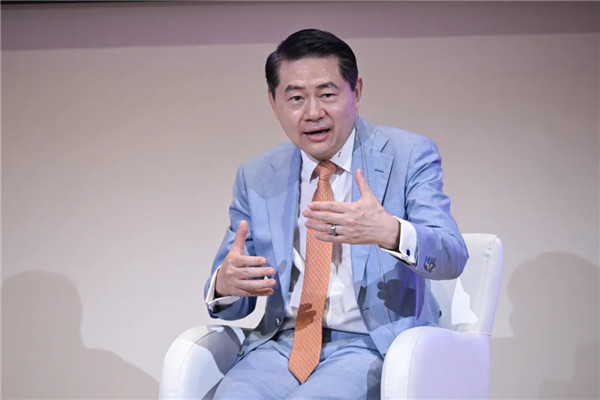
Wang Huiyao’s Speech @ Global Young Leaders Dialogue Annual Forum 2025
CCG | November 19 , 2025At the Opening Ceremony on November 19, Dr. Henry Huiyao Wang, Founder and President of CCG and Former Counsellor of the State Council of China, delivered a keynote speech titled “Decoding the Future: China’s Path to Green Globalization and Sustainable Transformation.”
Wang Huiyao’s Speech @ Global Young Leaders Dialogue Annual Forum 2025

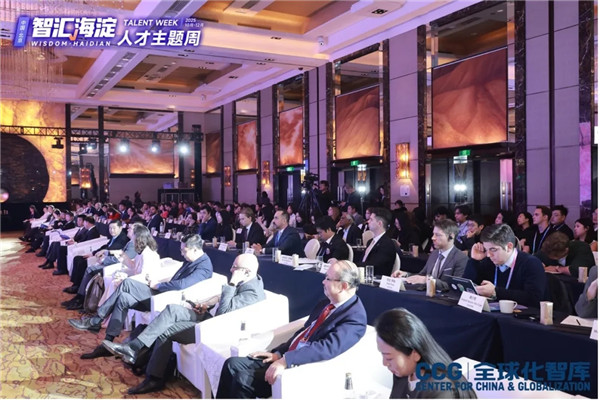
Themed “Decoding the Future with Young Minds,” the Global Young Leaders Dialogue Annual Forum 2025 was successfully held in Beijing’s Haidian District from November 18 to 20. The event was hosted by the Center for China and Globalization (CCG), co-organized by the Secretariat of the Global Young Leaders Dialogue (GYLD) program, and supported by the Haidian District Human Resources Bureau and the Haidian District Foreign Affairs Office. At the Opening Ceremony on November 19, Dr. Henry Huiyao Wang, Founder and President of CCG and Former Counsellor of the State Council of China, delivered a keynote speech titled “Decoding the Future: China’s Path to Green Globalization and Sustainable Transformation.”
Below is the full speech of Dr. Henry Huiyao Wang. The English transcription and Chinese translation are for reference only; please refer to the video speech for the accurate content.
Distinguished Chairman Liu, Secretary-General Gao, Madame Amakobe Sande, Professor Ya-Qin Zhang, distinguished young leaders, dear guests, ladies and gentlemen.
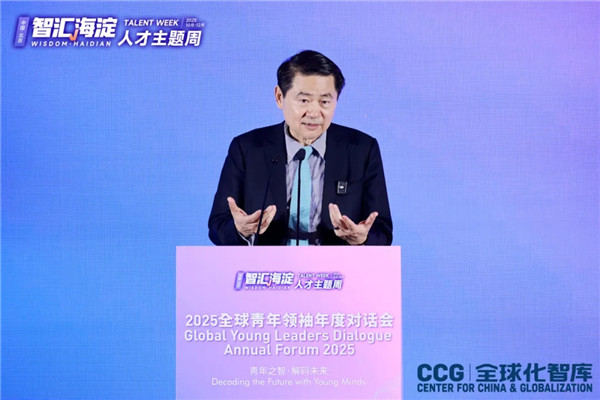
It is really a great honor to welcome all of you to the Global Young Leaders Dialogue Annual Forum 2025. This is the fifth time we are doing this. I remember when we started this, Madame Amakobe was the acting UN coordinator, and she actually helped us launch this event, so we are very pleased to see her coming back again. And we are very grateful to be here at this particular place, which is the silicon valley of China, basically in Haidian’s Zhongguancun. We are at the right place at the right time. And we heard what professor Ya-Qin ZHANG just mentioned about the AI that is taking place. This year’s theme, Decoding the Future with Young Minds, is very timely and essential. We are living through an era of profound transformation. As President Xi always says, we are seeing the changes unseen in a hundred years’ time. Globalization is shifting its logic, climate action is becoming a defining global agenda, and technological innovation is reshaping the international landscape we are living in right now.
For the global young leaders who gather here, this moment is not only a challenge but also an unprecedented opportunity. You are the generation that will live the longest with the consequences of today’s decisions—and the generation best positioned to rethink, redesign and rebuild the systems that will shape our world. Thank you all for coming today. We have [nearly] 30 young leaders and other participants from 40 or 50 countries. Your ability to understand these forces, and more importantly, to act as a bridge across cultures, sectors and societies, will be crucial in defining our shared future. It is with this spirit that I would like to share three perspectives that may help illuminate the broader direction of global change and China’s evolving role in globalization.
First, we are entering an new era of Green Globalization. I define that as green globalization. Traditionally, globalization was driven by trade liberalization, capital flows and technology diffusion. Today, however, geopolitical tensions, supply chain restructuring, climate pressures and digitalization are giving rise to a new model of global integration—one where green transition is at the core. In the 19th century, Britain led the Industrial Revolution through the steam engine. So we see that Britain was the leader of globalization in the 19th century. In the 20th century, the United States shaped global order with electrification, semiconductors, the Internet, and probably AI, too. The US was leading the 20th century. In the 21st century, I think China is emerging as a central driver of the global energy transition. For example, China’s energy production is 2.5 times that of the US and three times that of Europe. China now leads the world in renewable energy capacity—70 percent of renewable energy comes from China—and also in solar, wind production, and electric vehicles. China is the largest producer of EV cars. It reflects the rise of a green technology ecosystem that lowers the cost of decarbonization worldwide. China is actually leading the green globalization. [Green globalization is not an extension of] the old model, but the beginning of a new phase of global development. We have to change the paradigm. We are going to be led by this green globalization transition. So that’s my first observation.
Second, China has just passed the 15th Five-Year Plan (2026–2030) at the fourth plenum of the 20th Party Congress. This new Five-Year Plan will play a pivotal role in shaping both China’s trajectory and the future of global development. This new plan marks a strategic shift toward high-quality, innovation-driven, and green-oriented growth. It will place strong emphasis on developing “new quality productive forces”—including artificial intelligence, advanced manufacturing, life sciences, renewable energy, EV cars, and new materials—sectors that will power China’s next stage of modernization and probably also give new impetus to the new globalization that is going on right now. It will deepen China’s comprehensive green transition through the expansion of carbon markets, accelerated clean energy deployment, green finance, and low-carbon industrial transformation. And it will advance high-standard opening-up, strengthen cooperation with the Global South and the rest of the world, and promote a more sustainable and inclusive Belt and Road Initiative, which is the largest initiative China proposed for the world. The 15th Five-Year Plan reflects China’s evolving strategy: from pursuing a high-speed to pursuing high-quality development, from industrial catch-up to innovation pioneer in the green field. For the world, it offers a crucial window into how China intends to align domestic transformation with the global sustainable development goals of the UN.
My third observation, which is the final one, is to truly decode China’s future. We must understand how China’s development engine is shifting—from what some scholars call the “China Shock” to what I describe as a “Future Shock.” China’s advantage is no longer solely based on scale or magnitude, but on the combination of large-scale innovation. Every year, China has 13 million college graduates, and almost half of them are STEM-related. That’s remarkable and China is the largest talent-producing country in the world. Chinese companies are becoming key players in the worldwide green transition: BYD is helping electrify global transportation; Huawei is building the backbone of a greener digital economy; LONGi and CATL are driving solar and energy-storage revolutions across continents. These companies are not just “going global”; they are becoming global partners that offer solutions for the next phase of globalization—the green globalization. This integration of green technologies, digital systems and sustainability strategies will pave the new way for the next generation of globalization development. This marks a new stage of China’s global engagement: from exporting products to co-creating value, from setting up manufacturing plants around the world to helping countries build a greener and better world that we all live in. We need to work with all these countries—China, the US, EU, the Global South—to embrace this green globalization and strengthen our cooperation.
Ladies and gentlemen, the future belongs to those who dare to innovate and who embrace openness, collaboration and shared responsibility. Green globalization offers us a pathway toward a sustainable world. The 15th Five-Year Plan outlines how China intends to contribute to that transformation. “Decoding the Future with Young Minds” requires all of us—especially the young leaders here today—to engage with these shifts, build bridges across cultures and systems, and cultivate the mindset needed for a more interconnected, greener, and more resilient global community.
I thank you all very much.